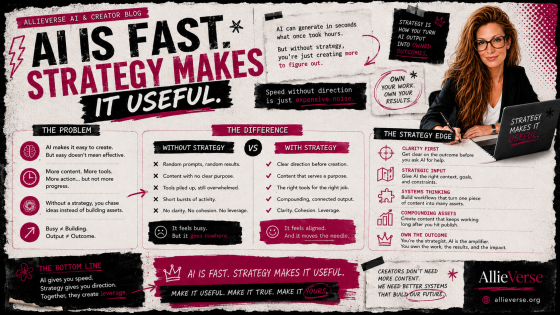
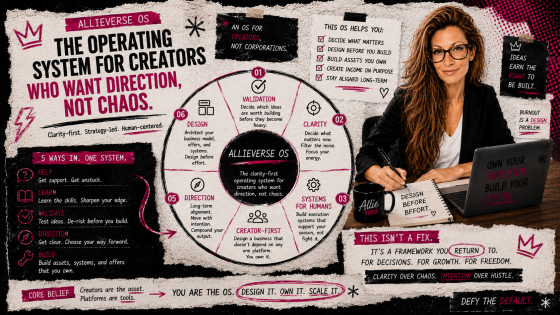
The Platform Map for Creators
 Allie Miriam

Learn how to build a creator platform map that assigns clear roles to each platform so your business stays flexible, owned, and built with direction.
The Platform Map for Creators
Bring snacks. This one has layers.
In this post, we’re going to explore how creators can choose platforms more strategically, assign each one a clear role, protect what they actually own, and build a business that stays flexible even when tools, algorithms, or trends change.
This isn’t about getting it perfect. It’s about building something you can continue inside real life, even as platforms shift.
What We’ll Cover
- What a platform map actually is
- Why creators need this more than ever
- The shift from platform-first to creator-first
- The 5 layers of a creator platform map
- Why every platform needs a job
- How to align your platform map with the creator journey
- How to build your platform map
- What platform flexibility actually means
- Signs your platform map needs work
- A practical example
- The real goal
- FAQs
Creators are drowning in platform advice.
Be on Instagram.
Start a YouTube channel.
Build a newsletter.
Try Substack.
Use TikTok while it still works.
Start a community.
Launch a course platform.
Repurpose everything everywhere.
None of this sounds unreasonable on its own.
That is part of the problem.
Every platform can be defended. Every tool has a use case. Every strategist has a diagram. Every creator has a story about the one platform that changed everything for them.
So creators do what seems responsible.
They try to build in all the right places.
They create content for discovery in one place, deeper trust in another, email somewhere else, products on another platform, community in a separate environment, and a checkout tool dangling off the side like an afterthought.
From the outside, it can look sophisticated.
Underneath, it often feels fragile.
You are never fully sure whether you are building an ecosystem or managing a digital scavenger hunt.
This is exactly why creators need a platform map.
Not another list of the best platforms.
Not another trend report.
Not another “must-have” tech stack.
A platform map helps you decide what each platform is for, what role it plays, what it should never be responsible for, and how your business keeps functioning even when one piece changes.
Because platforms are useful.
But platforms are not a business plan.
What a Platform Map Actually Is
A platform map is a way to see your business across roles instead of across apps.
It helps you answer questions like:
- What platform helps people discover me?
- What platform helps them trust me?
- What platform helps them take the next step?
- What platform delivers the actual experience?
- What do I actually own?
- What happens if one of these tools changes tomorrow?
Most creators do not have a platform strategy.
They have a pile.
A pile of accounts.
A pile of subscriptions.
A pile of half-connected workflows.
A pile of advice borrowed from people with completely different businesses.
A platform map turns that pile into structure.
It gives every platform a job.
Why Creators Need This More Than Ever
Creators are living inside a very crowded digital landscape.
There are more ways to build than ever.
There are more platforms than ever.
There are more people teaching platform strategy than ever.
And somehow, many creators feel less certain than ever about where to put their energy.
That uncertainty is not random.
It is usually a decision problem, not an options problem.
When creators start with the platform, strategy gets built around what the platform rewards instead of what the business actually needs.
That is how a distribution channel quietly becomes the boss.
This is why a platform map matters.
It helps you decide before you build, so platforms support your business instead of shaping it by default.
The Core Shift: From Platform-First to Creator-First
Most creators are accidentally taught to think in this order:
Where is attention?
What content works there?
How do I adapt to that?
What should I build inside it?
A creator-first platform map flips that.
What am I building?
What kind of relationship am I trying to create?
What needs to be owned?
What can be borrowed?
Which platforms support the business instead of defining it?
Creators are the asset. Platforms are tools.
This is not about avoiding platforms.
It is about designing a system that can continue even when they change.
69fe687306a34_lg.png)
The 5 Layers of a Creator Platform Map
Every platform in your ecosystem should have a job.
1. Discovery
First contact. Visibility. Reach.
2. Trust
Depth. Understanding. Relationship.
3. Conversion
The next step. Movement.
4. Delivery
The actual experience.
5. Ownership
What you control, move, and rebuild from.
Ownership is what makes adaptation possible.
The Core Rule: Map the Role, Don’t Marry the Platform
Map the role. Don’t marry the platform.
Creators are the asset. Platforms are tools.
If a platform doesn’t have a clear role, it’s creating drag in your system.
Build a Business That Can Move
You do not need to be everywhere.
You need a system where:
- people can find you
- understand you
- trust you
- take the next step
- stay connected in ways you can actually sustain
Because the strongest creator businesses are not built on platforms.
They are built on systems that can continue when platforms change.
Categories: AllieVerse OS
Categories: : Creator-First