Burnout Is a Design Problem
 Allie Miriam
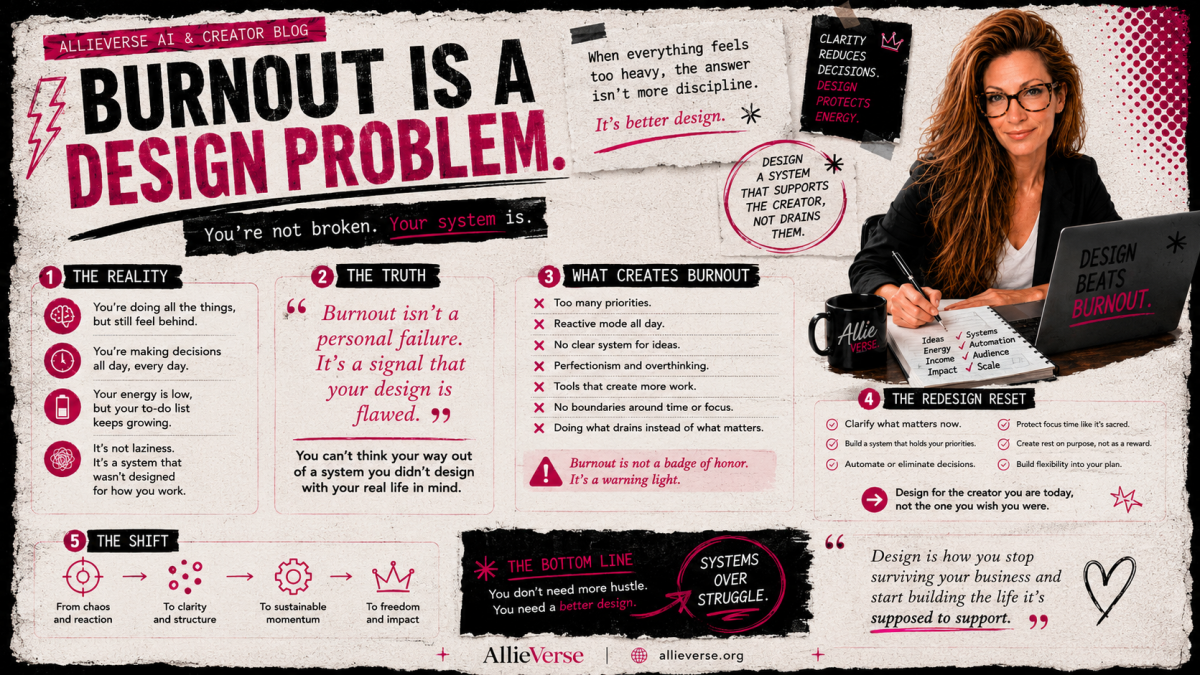
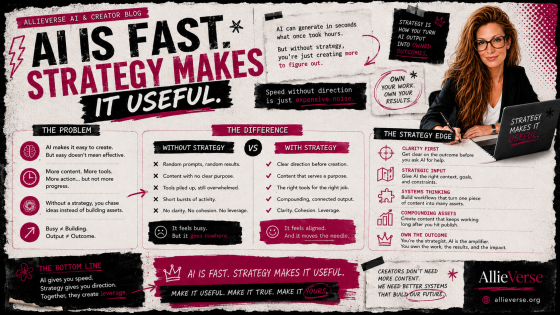
Burnout isn’t a mindset failure. It’s a design problem. Learn how intentional business design replaces constant effort & creates sustainable momentum
Burnout Is a Design Problem
Most creators don’t break down because they’re weak, lazy, or unmotivated.
They break down because too much of the business depends on effort.
More pushing.
More remembering.
More deciding.
More holding everything together manually.
At some point, that stops feeling like momentum and starts feeling like strain.
Not because the creator failed.
Because the structure underneath the work was never designed to carry the weight of a continuance arc.
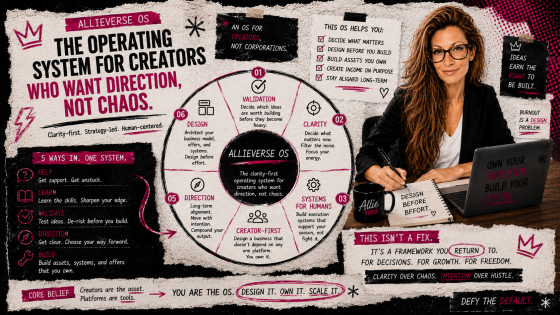
This post is part of the AllieVerse OS, a clarity-first operating system for creators who want direction instead of chaos.
The OS is made up of six core components that govern how decisions get made inside a creative business: Validation, Clarity, Systems for Humans, Creator-First, Direction, and Design.
These are not steps to complete. They are flexible components that work together to support how decisions get made across your business.
You can explore a quick overview of the full system here, or read the in-depth breakdown of every component here.
This post focuses on the Design component, and what changes when the business is intentionally structured to stay livable as it grows.
The 6 Core Components
- Validation – Ideas earn the right to be built.
- Clarity – Thinking beats hustling.
- Systems for Humans – Systems are creative tools, not cages.
- Creator-First – The creator is the asset. Platforms are tools.
- Direction – Consistency without direction is busywork in public.
- Design – Burnout happens when effort replaces design.
Why Effort Eventually Stops Working
Effort can carry a business for a while.
You work longer.
You push harder.
You compensate for gaps with willpower.
But effort is expensive.
It costs energy.
It costs attention.
It costs recovery.
And when effort is doing the work structure was supposed to do, strain is not far behind.
The Difference Between Effort and Design
Effort asks you to show up again and again.
Design removes the need to re-decide, re-build, and re-push the same things over and over.
Design looks at the business as a whole and asks:
- Where does friction show up repeatedly?
- What relies too heavily on motivation?
- What breaks the moment life intervenes?
These are design questions, not character questions.
What Design Actually Means (In the AllieVerse OS)
Design is not about rigidity or perfection.
It’s about intentional structure.
In the AllieVerse OS, design means shaping how energy flows through the business so progress does not depend on heroic effort.
This matters even more in a continuance arc, where energy, time, and attention are not predictable.
Good design creates slack.
It absorbs disruption.
It allows momentum to continue even when capacity changes.
Design is what makes a business livable, not just functional.
Why This Component Matters
Without intentional design, the business depends too heavily on the person holding it.
Things work only when you’re on.
Momentum exists only when you’re pushing.
Progress slows the moment life demands your attention elsewhere.
That kind of structure is fragile, even when it looks productive from the outside.
The Design component exists to change that.
It helps the business carry more of its own weight.
What Changes When Design Comes First
When design is intentional, pressure releases.
You stop rebuilding the same things.
You stop relying on constant force to keep momentum alive.
The business starts working with you instead of on you.
Sustainability becomes structural, not aspirational.
Progress becomes less dependent on your ability to keep compensating for weak structure.
The Core Rule: Design Carries What Effort Shouldn’t
Here’s the rule the Design component is built on:
Burnout happens when effort replaces design.
Design is how businesses stay livable over time, not just functional in short bursts.
Good design reduces the amount of progress that depends on force alone.
Strengthen the Structure Before Strain Becomes the Default
If progress only happens when you are pushing hard, that is not a personal flaw.
It’s a design signal.
You do not need to become more intense.
You need a business that asks less of force and more of structure.
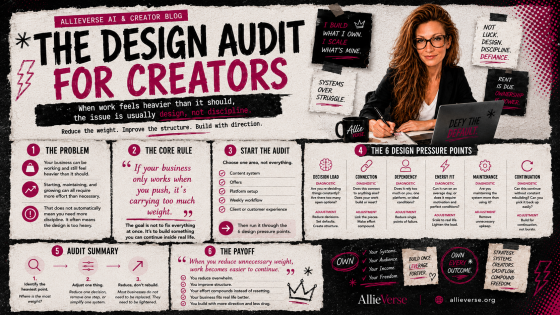
I created the Design Audit to help you identify repeated friction, reduce overreliance on effort, and build a business that feels more livable under real conditions.
Start Here
If you want the full system context, start with the OS pillar.
Read the AllieVerse OS pillar post
Then use the Design Audit to identify where your business depends too heavily on effort, and where stronger structure would make it more sustainable.
Categories: : Design