Design Audit for Creators
 Allie Miriam
Run a design audit to identify where your business is carrying unnecessary weight so you can reduce effort, improve structure, & build with direction
The Design Audit for Creators
Most creators don’t struggle because they lack effort.
They struggle because their business is carrying more weight than it needs to.
Things are working.
Content is going out.
Offers exist.
Progress is happening.
And yet, it feels heavier than it should.
Starting takes effort.
Maintaining takes effort.
Growing takes even more effort.
So you assume the problem is you.
More discipline.
Better consistency.
Stronger follow-through.
But when work feels heavier than it should, that’s usually not a discipline problem.
It’s design.
The Core Rule
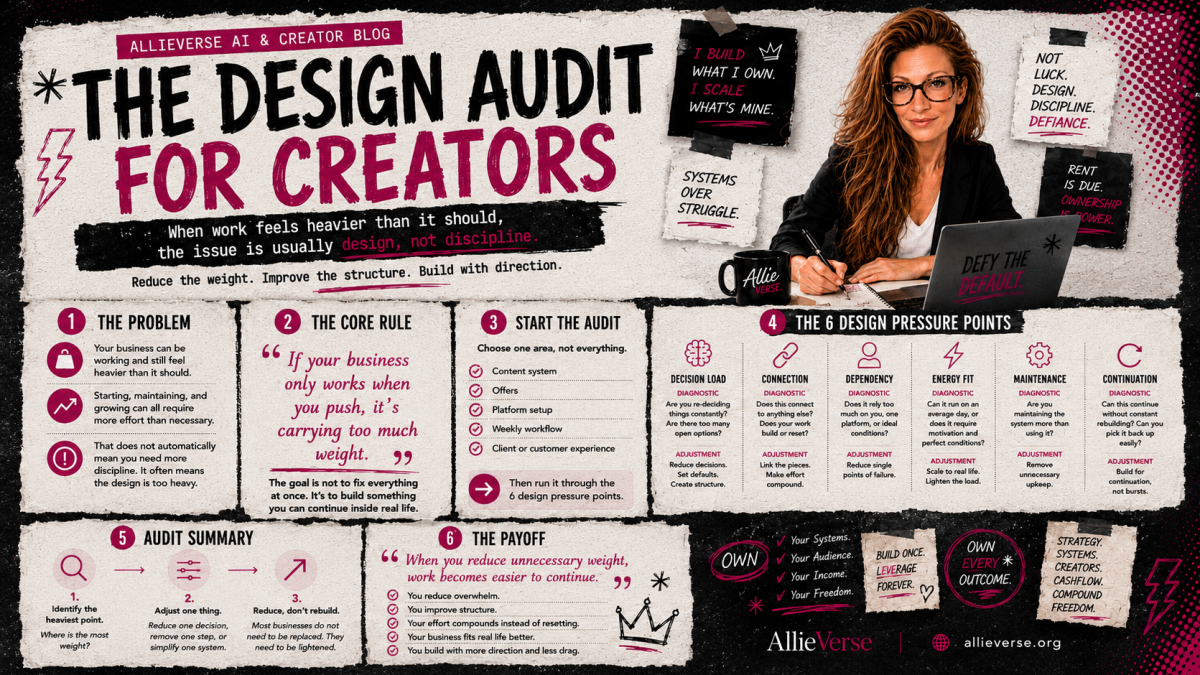
If your business only works when you push, it’s carrying too much weight.
That weight is not random.
It’s design.
This isn’t about fixing everything at once.
It’s about building something you can continue inside real life.
How to Run the Design Audit
Choose one area of your business.
Not everything. One.
Examples:
- your content system
- your offers
- your platform setup
- your weekly workflow
- your client or customer experience
Then run it through the six design pressure points below.
69fe67f422959_lg.png)
1. Decision Load
How many decisions are required to keep this running?
- Are you re-deciding things constantly?
- Does progress depend on figuring it out every time?
- Are there too many open options?
Adjustment: Reduce decisions. Set defaults. Create structure.
2. Connection
Does this part of your business connect to anything else?
- Does content lead to offers?
- Do offers connect to each other?
- Does work build or reset?
Adjustment: Link the pieces. Make effort compound.
3. Dependency
What does this rely on to function?
- Does everything depend on you showing up perfectly?
- Does one platform carry too much weight?
- Would this collapse if something changed?
Adjustment: Reduce single points of failure.
4. Energy Fit
Does this match real human capacity?
- Can this run on an average day?
- Does it assume ideal conditions?
- Does it require motivation to complete?
Adjustment: Scale to real life. Lighten the load.
5. Maintenance
How much upkeep does this require?
- Is this creating ongoing admin?
- Are you maintaining the system more than using it?
- Is the system becoming the work?
Adjustment: Remove unnecessary upkeep.
6. Continuation
Can this continue without constant rebuilding?
- Do you restart often?
- Does progress hold or disappear?
- Can you pick this back up easily?
Adjustment: Build for continuation, not bursts.
Audit Summary
1. Identify the heaviest point
Where is the most weight?
2. Adjust one thing
- reduce one decision
- remove one step
- simplify one system
3. Reduce, don’t rebuild
Most businesses don’t need to be replaced.
They need to be lightened.
Start Here
If you want the full system context, start with the OS pillar.
Read the AllieVerse OS pillar post
Then run this audit any time your business starts feeling heavier than it should.
Categories: : Design