The Direction Compass for Creators
 Allie Miriam
Use the Direction Compass to align your creator content, offers, and goals so your work starts compounding instead of scattering across disconnected
A practical reset for aligning your content, offers, and effort so your work starts compounding instead of scattering.
Most creators are not lazy.
They are not unwilling to show up.
They are not short on ideas, talent, effort, or ambition.
They are usually doing plenty. Posting. Planning. Creating. Reworking offers. Trying platforms. Learning new tools. Testing content angles. Showing up again and again.
And yet, something still feels off.
The work is happening, but it is not always building.
Content goes out, but does not clearly lead anywhere.
Offers exist, but do not feel connected.
Momentum appears in bursts, then disappears.
You are moving, but the business does not feel like it is moving with you.
That is usually not a consistency problem.
It is a direction problem.
This is where the Direction Compass comes in.
Not as another plan to manage.
Not as another content calendar.
Not as another tiny productivity gremlin whispering, “Just post more.”
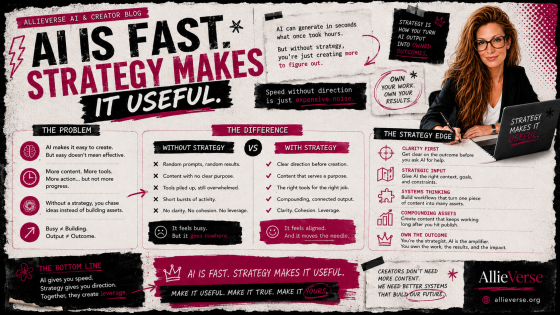
The Direction Compass helps you decide where your effort is meant to lead before you spend more energy creating.
Because consistency only matters when it is pointed at something.
This Post Is Part of the AllieVerse OS
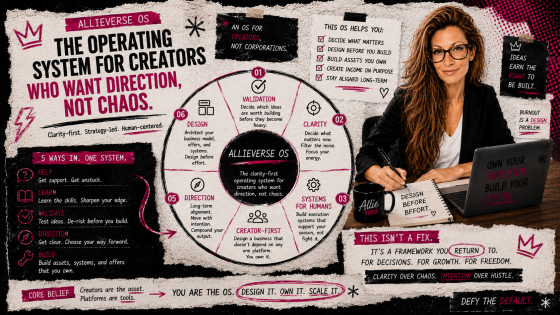
This post is part of the AllieVerse OS, a clarity-first operating system for creators who want direction instead of chaos.
The OS is made up of six core components that govern how decisions get made inside a creative business:
Validation, Clarity, Systems for Humans, Creator-First, Direction, and Design.
These are not steps to complete. They are components that work together to support how decisions are made across your business.
You can explore a quick overview of the full system here, or read the in-depth breakdown of every component here.
This post focuses on the Direction component, and how to align your effort so content, offers, and systems start working together instead of constantly resetting.
The 6 Core Components
- Validation - Ideas earn the right to be built.
- Clarity - Thinking beats hustling.
- Systems for Humans - Systems are creative tools, not cages.
- Creator-First - The creator is the asset. Platforms are tools.
- Direction - Consistency without direction is busywork in public.
- Design - Burnout happens when effort replaces design.
The Core Rule
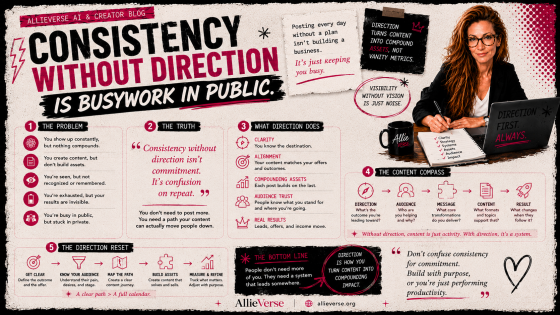
Consistency without direction is busywork in public.
Consistency is not the same as progress.
You can publish every day and still be unclear.
You can create a lot of content and still not build trust around the right thing.
You can launch offers and still leave people confused about what comes next.
Direction gives effort a destination.
It answers:
- What is this work meant to support?
- Where should this content lead?
- What offer, idea, or relationship is this building toward?
- How does this piece connect to the larger business?
- Is this effort compounding, or just keeping me visible?
Direction does not mean every move has to be perfectly strategic.
It means your work is not floating around like glitter in a ceiling fan.
There is a path.
There is a reason.
There is a destination.
Why Consistency Alone Does Not Compound
Creators are constantly told to be consistent.
Post consistently.
Email consistently.
Show up consistently.
Publish consistently.
Consistency matters, but it is not the whole system.
Consistency answers: Did I show up?
Direction answers: Did this move the right thing forward?
That second question is where compounding begins.
Without direction, effort often becomes scattered across disconnected outputs.
- A post here.
- A reel there.
- A newsletter about one idea.
- A sales page for another.
- A half-built offer that does not connect to the content.
- A new platform experiment because the current one feels stale.
Everything may be technically useful.
But useful is not the same as aligned.
When effort is not aligned, it resets instead of compounds.
What Direction Actually Means
In the AllieVerse OS, Direction is the component that gives your work a long-term path.
It is not the same as Clarity.
Clarity helps you decide what matters now.
Direction helps you decide where things are going.
Clarity reduces noise in the moment.
Direction creates continuity over time.
You need both.
Without Clarity, everything feels urgent.
Without Direction, everything feels disconnected.
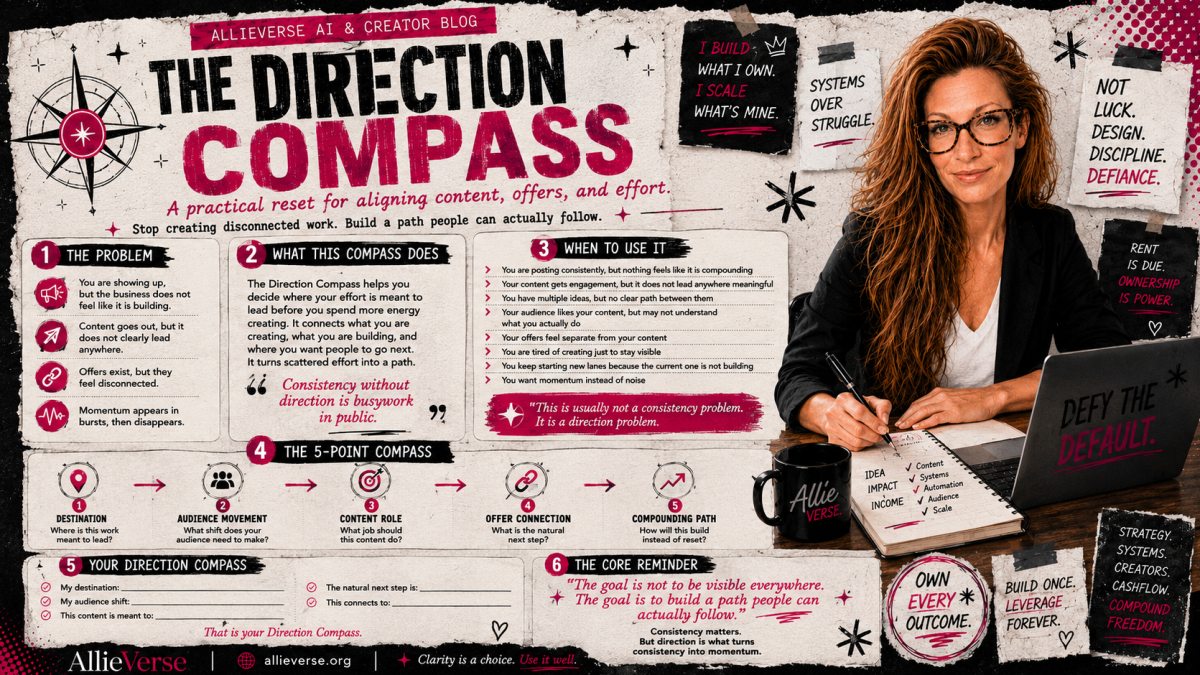
The Direction Compass helps you connect the dots between what you are creating, what you are building, and where you want people to go next.
It turns scattered effort into a path.
When to Use the Direction Compass
Use the Direction Compass when:
- you are posting consistently but nothing feels like it is compounding
- your content gets engagement but does not lead to offers, subscribers, sales, or deeper trust
- you have multiple ideas but no clear path between them
- your audience likes your content but may not understand what you actually do
- your offers feel separate from your content
- you are tired of creating just to stay visible
- you keep starting new lanes because the current one does not feel like it is building
- you want your work to create momentum instead of noise
This is especially useful before you:
- create a content plan
- launch a new offer
- start a series
- choose a platform focus
- rewrite your homepage
- build a funnel
- decide what to promote next
- commit to a visibility push
The Direction Compass is not a replacement for creativity. It gives creativity a road instead of a treadmill.
The Direction Compass Reset
Choose one current business goal, offer, or body of work.
Not your whole empire.
Not every idea you have ever loved.
One direction.
Write it at the top of a page. Then move through the five compass points below.
For each one, answer in plain language.
Do not make it fancy.
Do not turn it into a brand manifesto unless the brand manifesto gremlin has already breached containment.
Keep it useful.
69fe663b78bc0_lg.png)
1. Destination
Where is this work meant to lead?
Ask:
- What am I actually building toward right now?
- What do I want this body of work to support?
- Is this leading to an offer, a list, a community, a product, a service, a body of authority, or a larger ecosystem?
- If someone followed this path, what would the next step be?
Your destination does not need to be huge.
It just needs to be clear.
Examples:
- Grow trust around the AllieVerse OS
- Lead readers to the IdeaProof Workbook
- Help creators understand why their content needs a map, not just a plan
- Build authority around creator-first systems
- Move people from social content into the blog and newsletter
- Prepare an audience for a low-ticket tool
If you cannot name the destination, the work will drift.
Adjustment: Write one sentence that starts with: “This work is meant to lead toward…”
2. Audience Movement
What shift does your audience need to make?
Direction is not just about where you want people to go.
It is also about what they need to understand before they are ready to move.
Ask:
- What does my audience currently believe?
- What do they need to see differently?
- What problem are they aware of?
- What problem are they not seeing yet?
- What do they need to trust before the next step makes sense?
For example, if you want someone to use IdeaProof, they may first need to understand that too many ideas are not the real problem. The real problem is building before evidence.
If you want someone to use the Direction Compass, they may first need to understand that consistency alone does not create compounding progress.
If you want someone to join a membership, they may first need to understand that support is not just more content. It is structure, feedback, and a place to keep going.
Adjustment: Name the audience shift in one before-and-after statement.
Before: “They think they need to post more.”
After: “They understand their content needs a destination.”
3. Content Role
What job should your content do?
Not every piece of content has the same job.
Some content creates recognition.
Some builds trust.
Some teaches a practical step.
Some reframes the problem.
Some invites action.
Some deepens authority.
Some gives people language for what they are experiencing.
When every piece of content is expected to do everything, content gets muddy.
Ask:
- Is this content meant to attract, teach, reframe, nurture, convert, or retain?
- What should someone understand after reading or watching it?
- What should they be more ready for?
- Does this piece connect to the destination I named?
A strong content role keeps creation from becoming random.
Example roles:
- Reframe: “Your platform is not your business.”
- Teach: “Run this platform map before choosing another tool.”
- Nurture: “Here is why creator-first businesses feel more stable.”
- Convert: “Use the Creator-First Map to reduce platform dependence.”
Adjustment: Give each major piece of content one primary job.
4. Offer Connection
How does this work connect to what you sell, share, or invite people into?
This is where many creators lose direction.
They create content in one lane, offers in another, and audience expectations in a third mysterious hallway with questionable lighting.
Then selling feels awkward because the offer was never part of the path.
Ask:
- What offer, resource, or next step does this naturally support?
- Does the content prepare people to understand why that offer matters?
- Is the offer a logical continuation of the content?
- Would the next step feel helpful, or would it feel like a random trapdoor?
The goal is not to turn every post into a sales pitch.
The goal is coherence.
The reader should feel like the next step makes sense.
Examples:
- A post about ideas feeling heavy naturally leads to IdeaProof.
- A post about everything feeling important naturally leads to the Clarity Reset.
- A post about platform fragility naturally leads to the Platform Map.
- A post about scattered consistency naturally leads to the Direction Compass.
Adjustment: Write the bridge between the content and the next step before you publish.
5. Compounding Path
How will this effort build instead of reset?
Direction is where momentum becomes cumulative.
Ask:
- Can this piece connect to existing content?
- Can it support an offer, page, email, video, or future product?
- Does it strengthen a core idea I want to be known for?
- Can I reuse or repurpose it without changing the message every time?
- Does this build a path people can follow?
Compounding happens when your work starts reinforcing itself.
- A blog post becomes a video.
- A video becomes a newsletter.
- A newsletter becomes a product section.
- A product section becomes a workshop.
- A workshop becomes a membership lesson.
Not because you are squeezing every drop out of one idea like a lemon in a tiny business corset.
Because the idea belongs to a larger path.
Adjustment: Identify one way this work can connect forward or backward in your ecosystem.
Direction Compass Summary
After you move through the five compass points, write down:
1. My Destination
This work is meant to lead toward:
2. My Audience Shift
Before, they believe:
After, they understand:
3. My Content Role
This content is meant to:
4. My Offer Connection
The natural next step is:
5. My Compounding Path
This connects to:
That is your Direction Compass.
Not a content calendar.
Not a launch plan.
Not a giant strategy document that slowly becomes furniture.
A directional filter.
Use it before you create more work.
What This Changes
When you use the Direction Compass, your work stops feeling like a pile of separate efforts.
Content has a role.
Offers have context.
Your audience gets a path.
Your effort starts reinforcing itself.
You stop asking, “What should I post today?” as if the algorithm is hiding in the shrubs with a clipboard.
You start asking, “What needs to move forward, and what kind of content would support that?”
That is a very different question.
It creates a very different business.
Bookmark This Before You Create More Content
Bookmark this post and come back to it before your next content planning session, launch push, offer refresh, or platform sprint.
You do not need more disconnected effort.
You need effort that knows where it is going.
The Direction Compass helps you align content, offers, and goals so your work can compound instead of constantly resetting.
Because the goal is not to be visible everywhere.
The goal is to build a path people can actually follow.
Consistency matters.
But direction is what turns consistency into momentum.
Categories: : Direction