If Your System Only Works on Your Best Days, It’s Not a System
 Allie Miriam
If your system only works on your best days it’s not sustainable. Learn how to build human-centered systems that support consistency & prevent burnout
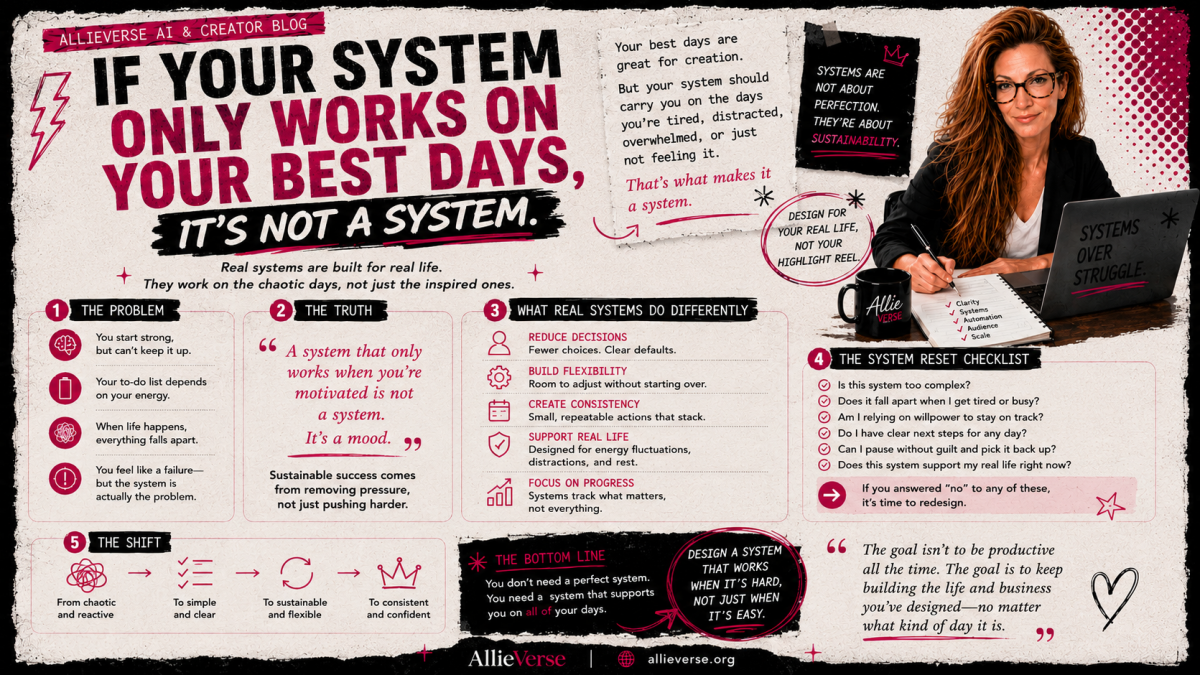
If Your System Only Works on Your Best Days, It’s Not a System
Most creators don’t fail because they lack discipline.
They fail because their systems assume unlimited energy.
The plans look good on paper.
The workflows make sense in theory.
The routines work… until life shows up.
A low-energy day.
A sick kid.
A bad night of sleep.
An unexpected interruption.
And suddenly, the system collapses.
Because real work happens inside continuation, not ideal conditions.
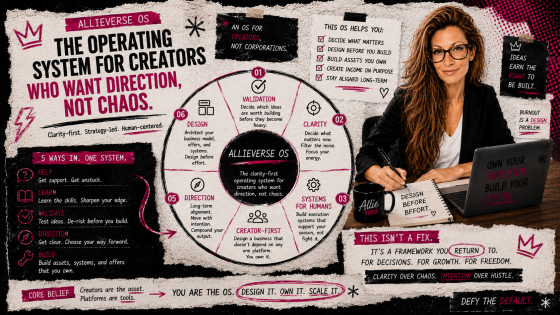
This post is part of the AllieVerse OS, a clarity-first operating system for creators who want direction instead of chaos.
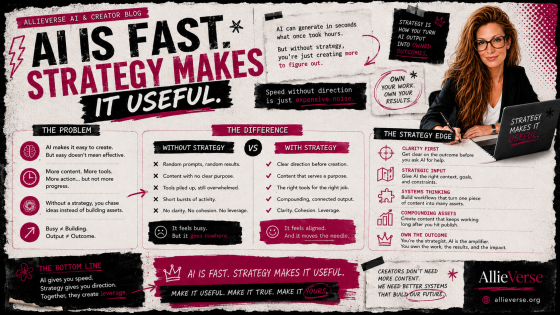
The OS is made up of six core components that govern how decisions get made inside a creative business: Validation, Clarity, Systems for Humans, Creator-First, Direction, and Design.
These are not steps to complete. They are flexible components that work together to support how decisions get made across your business.
You can explore a quick overview of the full system here, or read the in-depth breakdown of every component here.
This post focuses on the Systems for Humans component, and what changes when systems are designed to support real life instead of ideal conditions.
The 6 Core Components
- Validation – Ideas earn the right to be built.
- Clarity – Thinking beats hustling.
- Systems for Humans – Systems are creative tools, not cages.
- Creator-First – The creator is the asset. Platforms are tools.
- Direction – Consistency without direction is busywork in public.
- Design – Burnout happens when effort replaces design.
Why Most Systems Break in Real Life
Most systems are built for ideal conditions.
Perfect focus.
Consistent motivation.
No interruptions.
But creative businesses aren’t built in labs.
They’re built in real life.
When a system only works when you’re at your best, it doesn’t support you.
It judges you.
The Hidden Cost of Rigid Workflows
Rigid workflows don’t just fail quietly.
They create friction.
You hesitate to start because the process feels heavy.
You avoid tasks because they require too much setup.
You fall behind and feel guilty instead of supported.
Over time, consistency becomes a character test instead of a design feature.
What Systems for Humans Actually Means (In the AllieVerse OS)
In the AllieVerse OS, systems are not meant to control you.
They’re meant to support you.
Systems for humans are designed around:
- limited energy
- fluctuating focus
- real-life interruptions
They are built for real ones.
They are built to support continuation, not perfect conditions.
They reduce the number of decisions you have to make and make progress possible even on average days.
A system that survives low-energy days is a system that compounds.
Why Creators Resist Systems
Many creators associate systems with rigidity.
They’ve tried workflows that felt suffocating.
Schedules that killed creativity.
Rules that left no room for intuition.
So they avoid systems altogether.
Or they build overly complex ones that collapse the moment life changes.
The issue isn’t systems.
It’s systems designed without humans in mind.
What Changes When Systems Support Real Life
When systems are designed for humans, pressure drops.
You stop relying on motivation to begin.
You stop re-deciding the same things over and over.
You stop burning energy just trying to stay organized.
Instead of forcing consistency, the system makes consistency the default.
The Core Rule: Design for Your Average Day
Here’s the rule the Systems for Humans component is built on:
If your system can’t survive an average day, it’s not sustainable.
Good systems don’t demand your best.
They protect your energy so your best work can happen when it matters.
Build a System That Can Hold Real Life
If your systems collapse the moment energy dips, that’s not a willpower issue.
It’s a design signal.
You don’t need more pressure.
You need a system that can support real life.
I created the Systems Reset to help you reduce friction, simplify what’s repeatable, and build workflows that can hold under real conditions.
Frequently Asked Questions About Systems
Why don’t most systems work for creators?
Most systems are built for efficiency, not sustainability. They assume perfect conditions and fail when energy, focus, or time fluctuate.
What are systems for humans?
Systems for humans are workflows and structures designed around real human constraints, including limited energy, interruptions, and changing capacity.
Can better systems prevent burnout?
Yes. Human-centered systems reduce friction, decision fatigue, and over-reliance on motivation, which are major contributors to burnout.
Do systems limit creativity?
No. Good systems protect creative energy by handling repeatable decisions so creativity can be used where it matters most.
Start Here
If you want the full system context, start with the OS pillar.
Read the AllieVerse OS pillar post
Then use the Systems Reset to design workflows that support your real life instead of breaking under it.
Categories: : Systems for Humans