IdeaProof: A Practical Validation Reset
 Allie Miriam
A practical validation reset for deciding whether an idea is ready to be built, paused, simplified, or released.
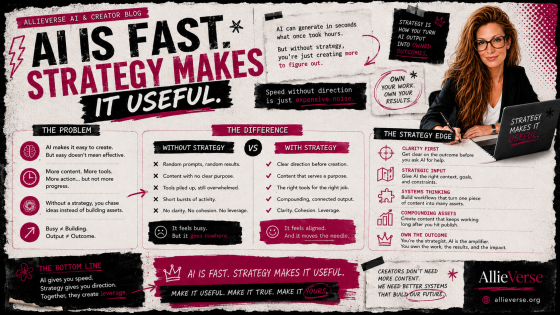
Most creators do not struggle because they lack ideas.
They struggle because every idea arrives carrying possibility.
- A course idea.
- A workbook idea.
- A membership idea.
- A newsletter idea.
- A template bundle.
- A challenge.
- A podcast.
- A tiny offer that somehow already has a logo, a domain, and three pricing tiers in your head.
The problem is not that you are too creative.
The problem is that ideas are very good at feeling urgent before they have earned weight.
So you start building.
- You outline the product.
- You sketch the funnel.
- You research the platform.
- You name the thing.
- You imagine the launch.
And by the time you realize the idea may not be clear, wanted, or worth the energy required, it already feels emotionally expensive to stop.
That is the moment for IdeaProof.
Not because your ideas need permission.
Because your energy deserves protection.
This Post Is Part of the AllieVerse OS
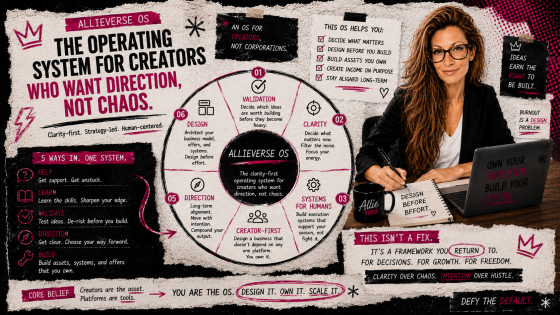
This post is part of the AllieVerse OS, a clarity-first operating system for creators who want direction instead of chaos.
The OS is made up of six core components that govern how decisions get made inside a creative business:
Validation, Clarity, Systems for Humans, Creator-First, Direction, and Design.
These are not steps to complete. They are components that work together to support how decisions are made across your business.
You can explore a quick overview of the full system here, or read the in-depth breakdown of every component here.
This post focuses on the Validation component, and how to test whether an idea has earned the right to be built before it starts consuming time, attention, money, and momentum.
The 6 Core Components
- Validation - Ideas earn the right to be built.
- Clarity - Thinking beats hustling.
- Systems for Humans - Systems are creative tools, not cages.
- Creator-First - The creator is the asset. Platforms are tools.
- Direction - Consistency without direction is busywork in public.
- Design - Burnout happens when effort replaces design.
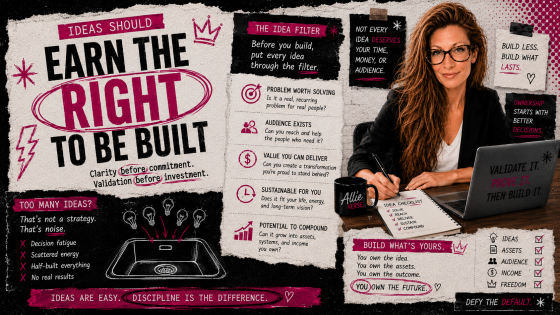
The Core Rule
Ideas earn the right to be built.
An idea does not become a project just because it feels exciting.
An idea does not become a priority just because it could work.
An idea does not become a business asset just because you can imagine it clearly.
IdeaProof helps you slow the leap between inspiration and execution so you can ask a better question first:
Has this idea earned the energy it wants from me?
That question changes everything.
Because some ideas are ready to build.
Some need to be simplified.
Some belong on the Idea Shelf.
Some are interesting, but not aligned.
Some are trying to become a business when they are really just a note, a post, a conversation, or a future seed.
Validation is how you tell the difference before the idea gets heavy.
Why Creators Overbuild Too Early
Creators are often told to move fast.
Launch before you are ready.
Take messy action.
Build the thing.
Get it out there.
There is value in momentum, but there is also a cost when speed replaces discernment.
When you build too early, you can end up investing in:
- ideas no one clearly asked for
- offers that solve a problem people do not feel urgently enough
- products that are too large for the actual demand
- content series that create attention but no movement
- projects that drain energy before they create evidence
The danger is not failure.
Failure is information.
The danger is emotional overbuilding.
That is when you give an idea so much time, identity, branding, structure, and hope that evaluating it honestly starts to feel like betrayal.
IdeaProof exists to interrupt that pattern.
What IdeaProof Actually Does
IdeaProof is not a guarantee.
It does not promise that every validated idea will sell perfectly, scale beautifully, or become the glowing centerpiece of your empire.
Tiny crown, not included.
IdeaProof gives you a cleaner decision point.
It helps you decide whether an idea has enough evidence to move forward, or whether it needs to be paused, reshaped, reduced, or released.
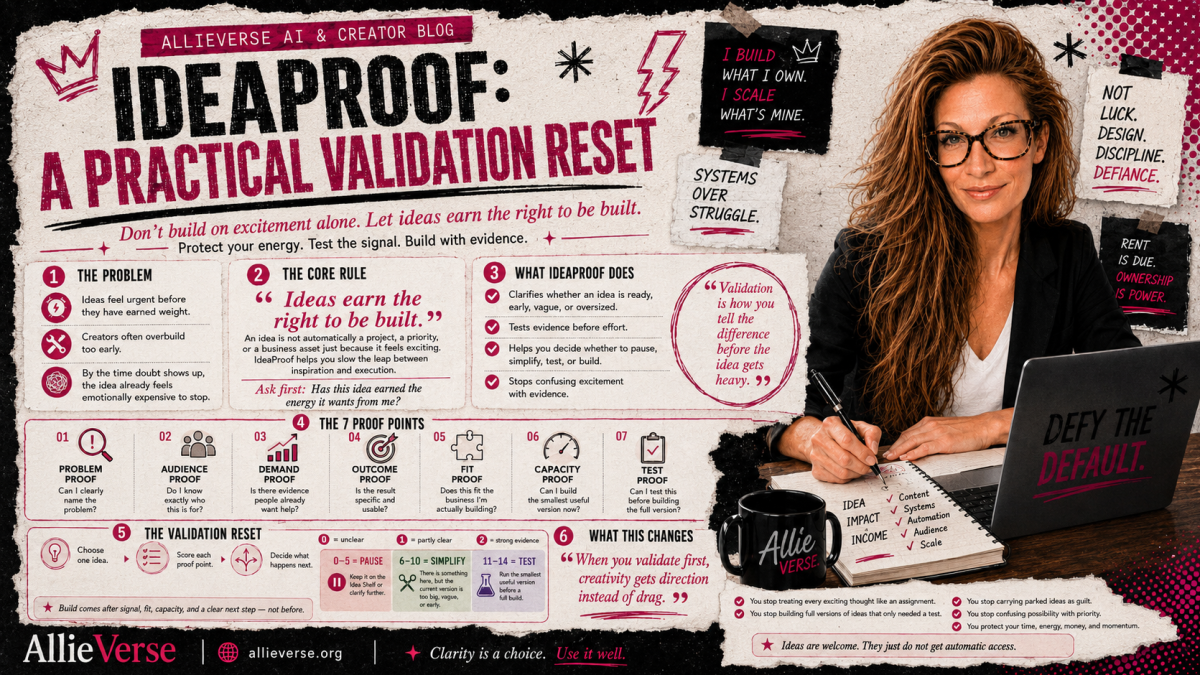
It asks:
- Is the problem real?
- Is the audience clear?
- Is there evidence of demand?
- Is the outcome specific?
- Is the build size appropriate?
- Does this idea fit the business I am actually building?
- Can I test this before I turn it into a full project?
The goal is not to remove risk.
The goal is to stop confusing excitement with evidence.
When to Use IdeaProof
Use IdeaProof when:
- you have a new offer idea and want to build it immediately
- you keep thinking about a project but cannot tell if it is actually worth prioritizing
- an idea feels exciting and heavy at the same time
- you are tempted to create the full version before testing the simple version
- you already named the idea and now feel weirdly attached to it
- you have too many possible directions and need a cleaner filter
- you are not sure whether something belongs in Now, Next, Parked, or the Idea Shelf
This is especially useful before you:
- build a course
- create a workbook
- launch a membership
- design a funnel
- write a long content series
- invest in branding
- buy tools or domains
- commit public energy to a new direction
IdeaProof is a pause before the plunge.
A little velvet rope for your own energy.
The IdeaProof Validation Reset
Choose one idea.
Not your whole business.
Not every possible offer.
One idea.
Write the idea at the top of a page, then run it through the seven proof points below.
For each proof point, score it:
- 0 = unclear
- 1 = partly clear
- 2 = strong evidence
At the end:
- 0-5 = Pause
The idea is not ready to build yet. Keep it on the Idea Shelf or clarify it further. - 6-10 = Simplify
There is something here, but the current version is probably too big, vague, or early. - 11-14 = Test
The idea has enough signal to earn a small test before you build the full version.
69fe66c9a8dda_lg.png)
1. Problem Proof
Can you clearly name the problem this idea solves?
Ask:
- What specific problem does this solve?
- Is this a problem people recognize in their own words?
- Does the problem create enough frustration, cost, delay, confusion, or desire for someone to care?
- Is the problem specific enough that the right person would feel seen quickly?
If you cannot name the problem clearly, the idea is not ready to carry a product.
Adjustment: Rewrite the idea as a problem statement before you build anything.
Example:
Instead of: “I want to make a creator planning workbook.”
Try: “Creators have too many ideas and no reliable way to decide which one deserves energy first.”
That is a sharper starting point.
2. Audience Proof
Do you know who this is for?
Ask:
- Who is already experiencing this problem?
- What do they call themselves?
- Where are they already trying to solve it?
- What stage are they in?
- What do they already believe about this problem?
“Creators” may be the broad audience, but most ideas need a sharper entry point.
- Course creators.
- Digital product builders.
- Newsletter writers.
- Coaches with too many offer ideas.
- New founders who keep overbuilding before testing.
The clearer the audience, the easier the idea is to test.
Adjustment: Name the smallest useful audience, not the biggest possible market.
3. Demand Proof
Is there evidence that people already want help with this?
Ask:
- Are people asking questions about this?
- Are they searching for solutions?
- Are they buying books, tools, templates, courses, or services related to it?
- Are competitors already solving part of the problem?
- Does the problem show up repeatedly in communities, comments, reviews, forums, or conversations?
Demand proof does not mean copying what already exists.
It means you are not building in a sealed glass jar of vibes.
Look for signals:
- Questions.
- Searches.
- Complaints.
- Workarounds.
- Purchases.
- Repeated language.
Adjustment: Collect at least three demand signals before upgrading the idea into a project.
4. Outcome Proof
Is the promised result specific enough?
Ask:
- What changes for the person after using this?
- What decision becomes easier?
- What problem becomes lighter?
- What can they do, choose, understand, or create afterward?
- Is the outcome concrete enough to explain in one sentence?
Weak ideas often have foggy outcomes.
They promise confidence, clarity, success, growth, or ease without naming the actual shift.
Strong ideas make the movement clear.
Before: “I have too many ideas and I do not know what to build.”
After: “I know whether this idea should be built, simplified, tested, parked, or released.”
That is a usable outcome.
Adjustment: Write the before-and-after in plain language.
5. Fit Proof
Does this idea fit the business you are actually building?
Ask:
- Does this support your current direction?
- Does it connect to your existing content, offers, or audience?
- Does it strengthen your ecosystem, or create another disconnected island?
- Is this aligned with what you want to be known for?
- Does this idea belong in your business now, or is it just interesting?
This is where shiny ideas get spicy.
Some ideas are good.
Some ideas are good for someone else.
Some ideas are good later.
Some ideas are useful, but not strategic.
Fit proof protects your business from becoming a museum of almost-related brilliance.
Adjustment: If the idea does not clearly connect to the business, move it to Parked or the Idea Shelf.
6. Capacity Proof
Can you build the smallest useful version without breaking your current system?
Ask:
- What is the smallest version that could create value?
- Do you have the time, energy, and attention to test it now?
- Would building this pull energy from something more important?
- Does the idea require a full product, or could it start as a post, worksheet, workshop, email, or short guide?
- Can this be tested before it becomes a full build?
A lot of ideas are not bad.
They are oversized.
They arrive wearing a cathedral costume when what you need is a clean little doorway.
Adjustment: Shrink the idea until it can be tested without becoming a life event.
7. Test Proof
Can you test this idea before building the full version?
Ask:
- What is the simplest way to test interest?
- Can you write a blog post first?
- Can you publish a short framework?
- Can you offer a tiny paid session?
- Can you ask your audience a specific question?
- Can you create a one-page tool before building the full product?
Testing is not a downgrade.
Testing is respect.
Respect for the idea.
Respect for the audience.
Respect for your capacity.
The full version should come after signal, not before it.
Adjustment: Choose one small test and run that before you build the bigger version.
Audit Summary
After you score the idea, decide what happens next.
1. Pause
Use this when the idea is interesting but unclear.
Move it to the Idea Shelf.
Do not punish it.
Do not keep carrying it in your head.
Let it wait without making it heavier.
2. Simplify
Use this when the idea has potential, but the current version is too big.
Make it smaller.
- Turn the course into a post.
- Turn the membership into a workshop.
- Turn the workbook into a checklist.
- Turn the giant framework into one decision tool.
3. Test
Use this when the idea has enough evidence to earn a small experiment.
Run the smallest useful version.
Watch what people do, not just what they say.
Collect signal.
Then decide whether it earns a bigger build.
4. Build
Use this only when the idea has evidence, fit, capacity, and a clear next test or offer path.
Build does not mean overbuild.
Build means the idea has earned structured effort.
What This Changes
When you use IdeaProof, ideas stop entering your business through the side door wearing a fake mustache.
You stop treating every exciting thought like an assignment.
You stop building full versions of ideas that only needed a test.
You stop carrying parked ideas as guilt.
You stop confusing possibility with priority.
Validation gives you a cleaner relationship with your own creativity.
Ideas are welcome.
But they do not get automatic access to your time, energy, money, or momentum.
They earn it.
Bookmark This Before You Build
Bookmark this post and come back to it before you turn your next idea into a full project.
You do not need to stop being idea-rich.
You need a better gate.
IdeaProof helps you decide whether an idea is ready to build, needs a smaller test, belongs on the Idea Shelf, or should be released before it becomes heavy.
Because not every idea is meant to become a product.
- Some are posts.
- Some are tools.
- Some are breadcrumbs.
- Some are future seeds.
- And some are just beautiful little chaos birds that need to fly away without becoming a business model.
The right idea does not just feel exciting.
It earns the right to be built.
Categories: : Validation